How to assess a viral mission list
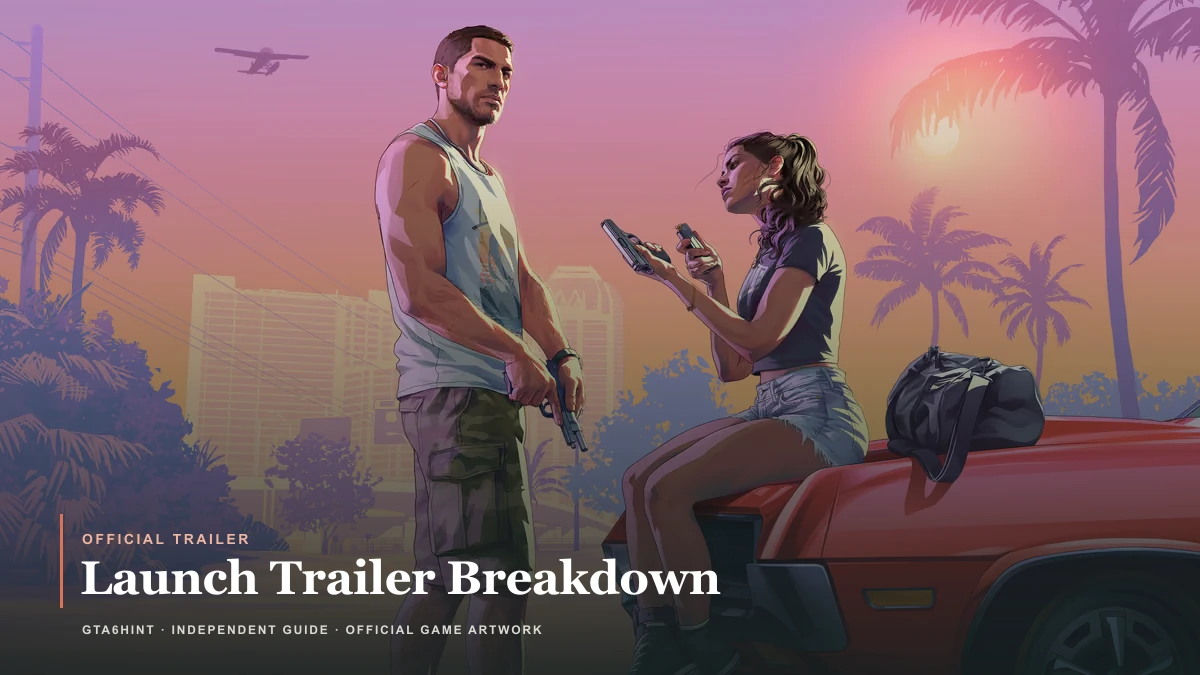
Fan posts often combine real names from Rockstar's trailers and character pages with invented mission titles, objectives, or rewards. A familiar location or a believable title is not evidence that the mission exists. Rockstar's published material introduces Jason, Lucia, and parts of Leonida, but it is not a complete mission index or an event registry.
What “verified” means here
GTA6Hint uses Confirmed only for a claim directly supported by Rockstar, Take-Two, a platform holder, or another primary source. A screenshot without a source, a cropped social post, or a list attributed to an unnamed insider remains unverified. We will not label a user-supplied list “fake” unless a source disproves it; we will label it accurately as unsupported until evidence is available.
The six mission names and the proposed safe combinations, UFO triggers, cryptid coordinates, and vehicle-fence tricks supplied for this project are not in this seed as game facts. Once gameplay is publicly available, this page can link to a mission or event only after its name and steps are checked against reproducible footage or an authoritative source.
Sources
- Rockstar Games: Only in Leonida character and location material
- Rockstar Games: official screenshots and media
Identify what the document actually is
A mission list needs more than a familiar logo and plausible names. Establish who published it, where the full version can be read, and whether its claimed origin can be checked. A repost can preserve the appearance of a document while dropping the context that would allow it to be evaluated.
The mission notebook uses an official source sequence as its identifier. It does not turn an interior seen in a trailer into a fully named mission with a chapter number and reward table.
Keep a frame’s conclusion narrow
A sign can help identify a location; it does not establish every activity that occurs there. A character holding an item does not prove a complete equipment system. Strong fact-checking keeps those smaller observations intact rather than replacing them with an equally unsupported counter-story.
The wildlife and mysteries guide applies the same standard to unusual background details. A recognisable motif can be worth investigating without becoming a confirmed quest trigger.
Preserve a useful correction trail
When evidence changes, explain which claim changed and link the new source. Quietly replacing a list of names leaves readers unable to understand why the earlier version was unreliable. A clear correction can be more useful than another round of confident predictions.
Before treating a list as a guide
- Find its original source and publication date.
- Check whether a claimed mission title appears in a publisher statement or playable objective.
- Use the completion roadmap to distinguish confirmed requirements from questions awaiting evidence.
Field note: A professionally designed graphic can still contain unsupported information. Evaluate the source before the presentation.
Questions & answers
Where does the article’s factual information come from?
Primary sources are linked in the article and its source list. The copy distinguishes a published statement from editorial explanation or an untested claim.
Does this article claim a hands-on test of the unreleased game?
No. Promotional analysis and public announcements do not establish a completed gameplay test, a universal performance target, or an unannounced mechanic.
How can I check whether information has changed?
Read the review date, follow the newest linked official source, and compare any dated update with older coverage before relying on a schedule or purchase claim.
Read our editorial policy for verification and corrections.