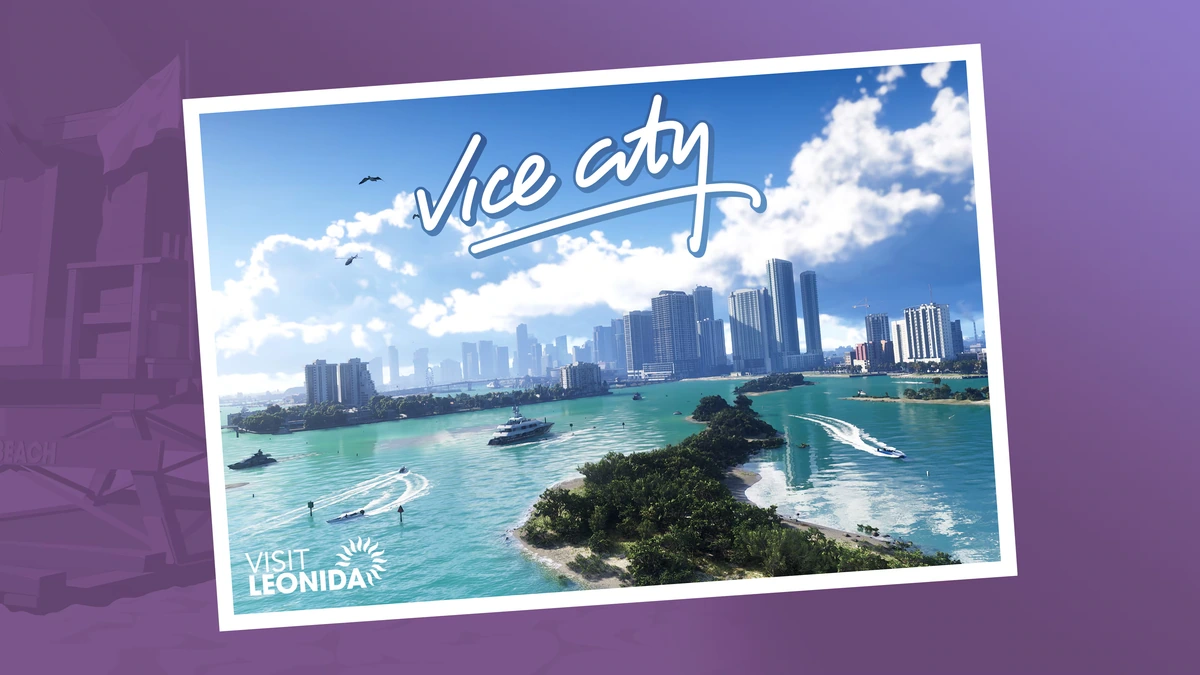
Vice City
Vice City is the most familiar name in Rockstar’s public description of Grand Theft Auto VI. The official site calls it part of Leonida and presents the city as the bright face of a darker story. Rockstar’s art archive gives a visual reference for its coast and built environment. The page does not supply a complete district list, road map or gameplay service directory, so this dossier keeps city analysis at the level the sources support.
The city’s return gives the series a recognizable point of entry while the wider region name signals that the story extends beyond the urban core. A reader can compare official artwork and trailer frames, but should not use perspective alone to claim the location of a property or mission. Our atlas links images to the Rockstar archive.
Leonida Keys
Rockstar names the Leonida Keys and connects Jason’s public biography to work for local drug runners there. The region artwork shows a southern island-chain impression, while Brian’s boatyard description gives the Keys a human and economic context. These are independent pieces of official material; together they suggest a setting associated with water and movement without proving every route or activity.
The publisher has not released a precise road network, ferry timetable or safehouse coordinate in the materials cited here. A guide should avoid claims that a particular bridge is open or that a named character’s property can be entered. When the game is playable, route notes can record which causeways and boats are usable and what the map actually displays.
Grassrivers
Grassrivers is one of the regions Rockstar names in its public world material. Official images establish that it belongs to the visual catalogue of Leonida; the region name invites comparison with wetlands and waterways. It does not give a complete biome boundary or prove that every visible channel is navigable. Screenshots should be credited and used as illustrations rather than treated as a cartographic survey.
After release, a player guide can document practical questions: which areas are reachable on foot, where the map changes color, how weather affects visibility and whether services are nearby. Until those observations are repeatable, this dossier uses Rockstar’s place name and leaves exact coordinates to the map team.
Port Gellhorn
Port Gellhorn is another official regional name and appears in Rockstar’s media collection through promotional imagery. Its public material establishes a distinct place in the state but does not publish a complete municipal layout or activity list. Fans may describe its visual references in more detail, but a reference is an interpretation until a direct source confirms it.
For strategy coverage, the relevant post-launch observations will be access, services, travel links, mission starts and repeatable landmarks. We will record tested coordinates only when another player can reproduce them. The news hub will call out official additions, while walkthrough pages will explain steps that have been tested on a recorded build.
Ambrosia
Rockstar includes Ambrosia among the named locations in Leonida. The official promotional set gives it a regional identity, but the public page does not describe every settlement, road or character connection. Any claim that Ambrosia contains a particular factory, gang headquarters or side activity needs a direct source beyond a suggestive image.
A strong world guide can make useful progress without pretending to know more than the publisher has shown. It can collect the exact official name, link the source art, record the date of the last check and leave room for a tested map later. That is the purpose of the region cards here: readers can identify what is official and see what remains a question.
Mount Kalaga National Park
Mount Kalaga National Park completes the six-region set used in this guide. Rockstar’s official name indicates a protected-area framing, and the media archive supplies visual references. The name alone does not confirm hiking systems, wildlife encounters, park boundaries, trail names or collectible locations. Those details must come from a later official map or the released game.
For players, a park guide should answer practical rather than speculative questions: how an entrance is identified, which routes are traversable, what the game’s map labels, and whether optional content is tied to time or weather. We will use screenshots with source credit and distinguish direct observation from a player’s inferred route. The hints hub will contain confirmed secrets only after they can be reproduced.
A source-led regional index
The six names provide a useful editorial scaffold for browsing Rockstar’s public material. They are not proof that the game’s map has exactly six districts or that each region receives equal story time. The publisher may use marketing categories that do not match an in-game completion menu. Until a released map exists, this page is a visual index, not a claim about world boundaries.
Use the official source archive, the latest news, and the mission directory alongside these regional notes. A guide with pins should display its source, tested version and confidence. If we add a fan-made regional diagram, it will be labeled approximate and will never replace the official art. GTA6Hint is an independent resource and makes no claim to own Rockstar’s imagery.
Geography in promotional material is not a playable map
Rockstar’s six public region names offer a useful geography vocabulary, but promotional material has a different purpose from an in-game map. Marketing images choose framing, weather and landmarks to introduce atmosphere. They do not reveal all boundaries or the ways one area connects to another. A coast seen in a trailer does not provide a reliable compass direction; a horizon line cannot establish a travel distance. A fan-made atlas can help organize these references only if it labels its own interpretation and never suggests the boundaries came from Rockstar.
Readers can still compare how the names and images create contrast. Vice City is presented as an urban setting, the Keys and Grassrivers evoke water and wetlands, and Mount Kalaga is explicitly named as a national park. Those are grounded observations about the language and published imagery. Claims about terrain systems, wildlife frequency, mission density or roads require the released game. We keep each region page tied to its original source so readers can review the same image and decide whether our description goes beyond what it shows.
A consistent method for building the atlas
A post-release regional atlas should record landmarks from repeatable player observation. Each marker needs a capture platform and game version, a coordinate method and a short description of how another player can find it. If an exact location is sensitive to a mission state, the record should say so. When players disagree, preserve the disagreement until a second run or a direct map label resolves it. This process makes the atlas more useful than a dense pinboard whose author cannot explain where the pins came from.
The same standard applies to collectibles and activity routes. Separate official place names from player-discovered labels, and distinguish a useful landmark from a confirmed objective. Link an individual activity to its mission walkthrough or hint page rather than making the map description carry every instruction. Our Leonida map is a regional index today; when verifiable coordinates become available, its source notes will show what is confirmed and what remains an estimate.
Read the character without predicting the ending
- Keep the published biography separate from an interpretation of a scene.
- Do not assign dates to a character’s past when the source supplies none.
- Compare Lucia’s dossier with Jason’s dossier before drawing conclusions about their shared plan.
Field note: A background detail can explain a motivation without proving a special ability. Record the source of each claim before adding it to a character timeline.
Questions & answers
Is a public biography a complete backstory?
No. The dossier preserves the published outline and leaves unannounced dates, missions, and outcomes open.
Does a biography confirm an exclusive tactical skill?
No. A playable ability needs its own gameplay evidence, including its input, effect, and limitations.
What is the spoiler scope?
The dossier discusses public source material and identifies interpretation. It does not present an invented ending as a reveal.
Read our editorial policy for verification and corrections.
GTA6Hint is an independent publication and is not affiliated with Rockstar Games or Take-Two Interactive.