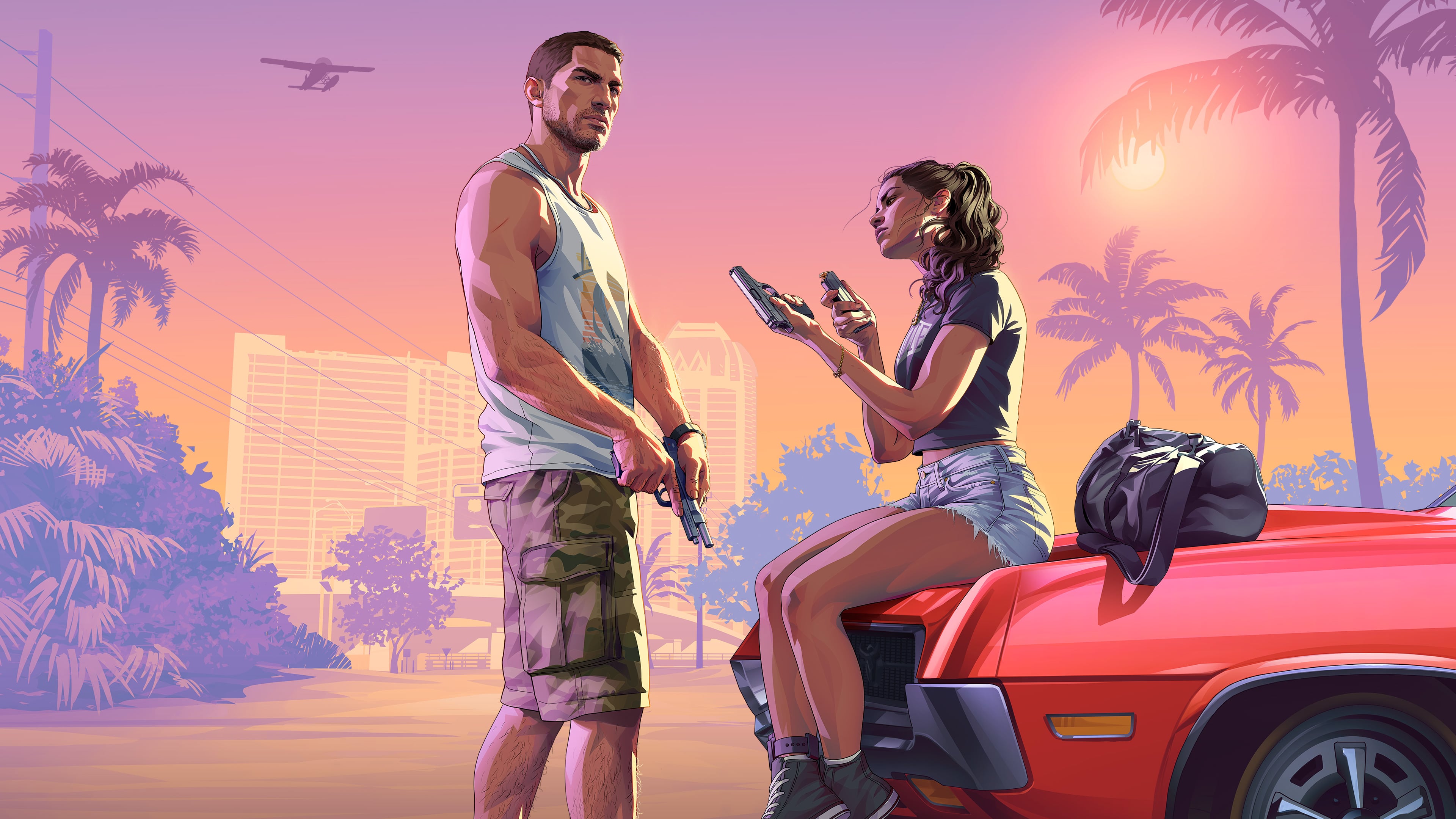
0:00 — The title and the final pre-launch frame
Rockstar published the Grand Theft Auto VI Launch Trailer on October 15, 2026. The official page gives that date and presents the video as a launch trailer. The word “launch” describes the marketing phase; it does not mean the game had launched. The page still lists November 19, 2026 as the scheduled release date in Rockstar’s current public materials.
This opening timestamp is a navigation point into the official upload. It helps viewers return to the same edit and assess the pacing. We avoid calling it a story prologue or a final gameplay build because Rockstar’s source does not make those claims.
0:15 — Public story framing
Rockstar’s wider game description says Jason and Lucia find themselves in the middle of a criminal conspiracy stretching across Leonida and are forced to rely on one another. The launch trailer’s presentation can be read alongside that sentence, but the publisher’s prose is the direct source for the premise.
The framing encourages viewers to think about partnership and risk. That is an editorial interpretation of the campaign, not a confirmed relationship system. Rockstar has not announced a hidden affinity meter or disclosed the ending in the public sources cited here. Our character dossiers keep those questions open.
0:33 — Mood, motion and cut length
The launch film uses pace and music to move the viewer through character and environment images. Shorter cuts can make the world feel restless; a held shot can give a line or expression more weight. Those are choices in the edit, not proof of the final game’s mission rhythm or camera control.
A close reading should compare sound and image without claiming that every transition represents a continuous scene. The song is identified in Rockstar’s Newswire, and its placement is part of the trailer’s public presentation. The credit does not establish that this exact recording appears on an in-game radio station.
0:50 — The music credit and its scope
Rockstar’s announcement identifies “Flower in a Hurricane,” by Justice featuring Tame Impala, SZA and King Gizzard & The Lizard Wizard, as the track making its debut in the trailer. That is a specific, sourceable music fact. It should not be stretched into a complete soundtrack list or a statement about every territory’s audio mix.
Music can shape how a viewer reads a scene. A hopeful lyric over dangerous imagery may create contrast, but it does not confirm a plot outcome. Our music guide follows official soundtrack and score announcements separately from analysis of this trailer.
1:08 — Watch for what the edit omits
Promotional edits are defined partly by what they leave out. A scene may begin after an event or cut away before its result. That omission can create suspense, but it is not evidence of a hidden choice. If the video shows a character entering a location and cuts before the interaction, the most accurate description is that the outcome is not shown.
A frame-by-frame article should keep this restraint visible. The timestamp links to the original source so a reader can judge the cut. Our future mission guides will document full objectives only after they are playable and verified.
1:20 — The final montage as a campaign statement
The closing portion brings the promotional images together into a final statement about the world and its protagonists. It is designed to leave a strong impression before the player can experience the game. The imagery can be discussed as marketing and film craft while leaving map geometry and gameplay controls open.
Compare the final trailer with the earlier reveal and extended look to see how Rockstar’s public presentation evolved. The official video archive links all of them. Our video hub keeps the four confirmed long-form uploads together and lets readers move between the analyses.
What is confirmed, and what remains a question
The publisher confirms the trailer title, release date and music credit. Rockstar’s official game page continues to list the November 19 release date and PS5/Xbox Series X|S platforms. These facts can be updated if Rockstar changes them. They do not prove that every scene is playable or that the trailer contains the final version of every visual.
Questions about mission order, weapon handling, vehicle performance, map size and online play need separate sources. We will not infer them from a music edit or a close-up. The news desk records new announcements; the walkthrough section marks gameplay work awaiting release.
A viewing checklist for the reader
Watch the source once without pausing, then use the timestamp buttons to revisit specific transitions. Note the visible action, the readable text, the camera perspective and the soundtrack. Put interpretation in a separate note. If you cite a claim elsewhere, link to the official Rockstar page and preserve the timestamp.
This simple routine makes analysis reproducible and prevents an edited shot from becoming a fake mission leak. Send corrections with the timestamp and source URL. We will verify the claim and preserve a correction date if the page changes.
A useful viewing routine
- Watch the official source uninterrupted before pausing individual frames.
- Keep the timestamp beside an observation and separate it from your interpretation.
- Use the region guide or character dossier for context rather than treating an edit as a mission order.
Field note: Replay at normal speed after inspecting a still. Motion and neighbouring shots often explain what a cropped image hides.
Questions & answers
Does the source play inside this page?
Yes. Play and chapter controls activate the official embedded video on this page. The source citation remains visible below the player.
Does the site force 4K playback?
No. Available resolution depends on the official upload, connection, device, and YouTube’s player controls.
Are the chapter labels official mission chapters?
No. They are editorial viewing checkpoints, not a claimed campaign sequence.
Read our editorial policy for verification and corrections.