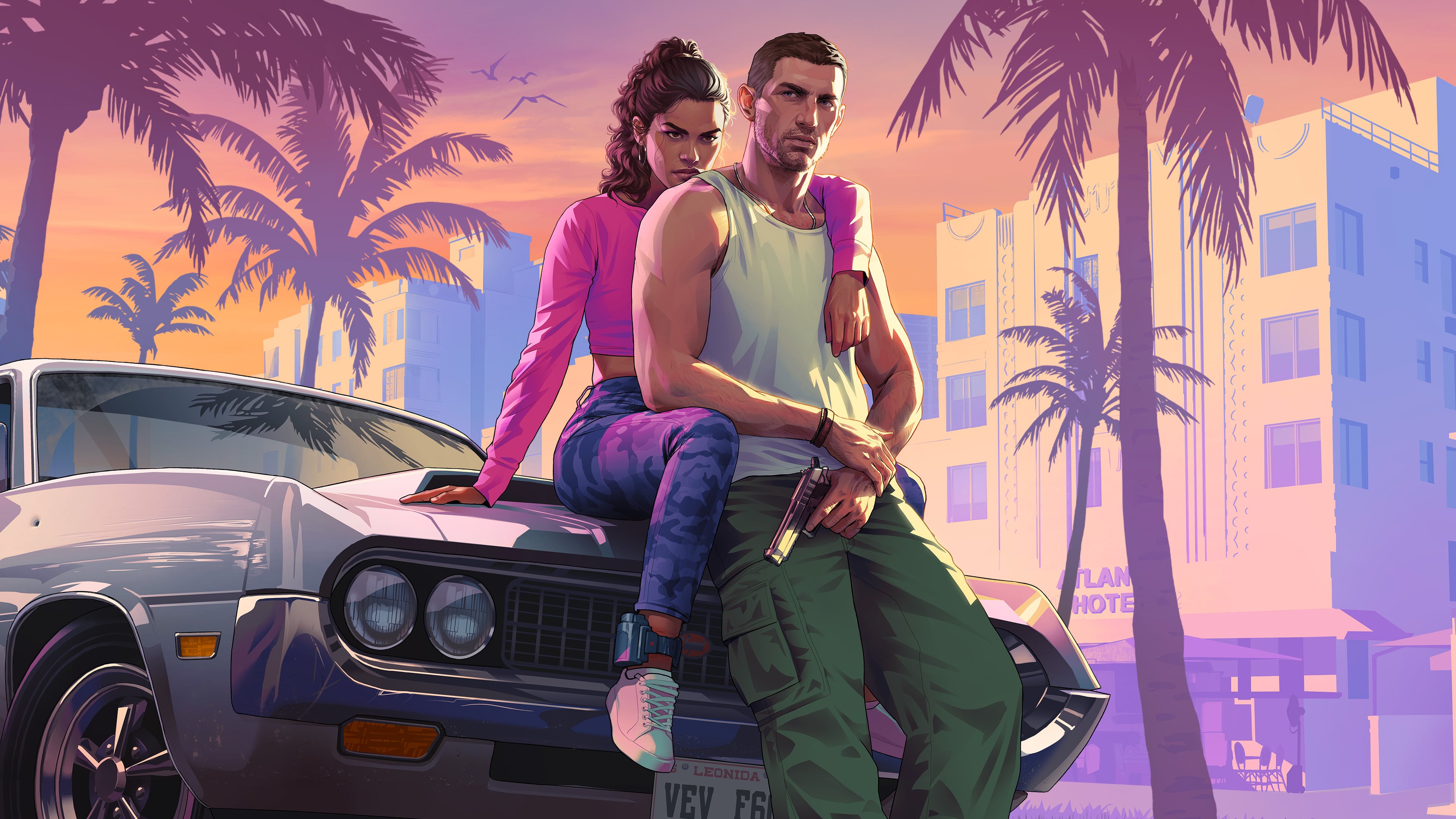
0:00 — Open on the world, not a mission title
The first trailer begins by establishing an atmosphere before it explains the central story. Its opening images introduce a sunlit, coastal setting and a collage-like public life. That is a deliberate way to make the world feel observed rather than diagrammed: the viewer sees the texture of a place before receiving a list of features. Rockstar’s own page identifies this as the first Grand Theft Auto VI trailer; the sequence itself is promotional editing.
The opening does not establish a player’s starting location, the order in which the scenes occur or the exact geography of the playable map. A good frame note records what is visible and leaves the map question open. Later in the game, players can compare a named landmark with an actual map. Until then, use the Leonida atlas to browse official source art rather than treating this montage as a coordinate guide.
0:21 — Lucia’s public introduction
The trailer brings Lucia into focus as a central figure and connects the character to the wider public imagery of Leonida. Her official biography later adds the publisher’s description of her prison history, family background and determination to make smarter choices. That biography is a better source for factual character context than trying to infer a backstory from a few seconds of edited footage.
A visual introduction can still shape the viewer’s impression. The edit emphasizes self-possession and a willingness to act, but those are readings of performance and framing. It does not establish the exact charge, a mission objective or a playable combat ability. Our Lucia dossier separates Rockstar’s written biography from interpretation.
0:44 — A montage is not a map
As the trailer moves through different locations and people, it suggests a state with a broad social range. The named regions now available through Rockstar’s materials provide better anchors for regional coverage than a screenshot alone. The viewer can recognize that the publisher wants Vice City and Leonida beyond it to feel connected, while the footage does not spell out a route between every shot.
The montage’s pace also compresses time. A cut can move from an interior to a road to a shoreline with no travel shown in between. That is useful for advertising because it creates variety, but it cannot tell a player whether the locations are close, how they connect or which region a specific activity belongs to. Our news archive records the dates when Rockstar names a place.
1:08 — The central relationship enters the frame
The trailer’s closing movement puts the protagonists’ relationship at the center of the pitch. Rockstar’s official game description later says Jason and Lucia are caught in a criminal conspiracy across Leonida and must rely on each other. That statement confirms the broad premise. It still does not tell viewers how the edit’s scenes line up in the story or whether every moment is interactive.
When reviewing promotional dialogue, listen to the line in its actual cut and avoid treating it as a complete conversation. An omitted reply or sound bridge may change the apparent meaning. Our story page links the official character profiles; spoiler-sensitive discussions can be added after the released game demonstrates what those lines refer to.
How to use the timestamps
The timestamp buttons on this page jump into Rockstar’s official upload. Labels describe broad visual transitions and are navigation aids, not mission chapter names. If Rockstar replaces or edits the upload, the visible scene may shift slightly; the timestamp should then be checked against the updated video. A frame-by-frame article is only useful when the reader can return to the same source.
Use the mission directory for playable objectives once they can be tested, and the hints hub for confirmed solutions. A trailer can tell us what the publisher chose to show; it cannot replace an in-game test of controls, mission order or rewards.
What the trailer confirms
Rockstar’s source confirms the video’s title, publication and place in the official media history. Later Rockstar pages establish the two protagonists, the setting in Leonida and the November 19, 2026 release date. These facts should be cited to their own source pages rather than inferred from a title card. The first trailer remains an important historical record of how the game was initially presented.
It does not confirm every theory attached to a character, animal or location visible in the edit. Readers should treat those as analysis until supported by a direct statement or a repeatable in-game observation. This distinction helps keep our video section useful to newcomers and fans returning to compare the early reveal with later official material.
A second viewing for readers
On a second viewing, track the movement from place to person and from person to premise. Note which shots include readable in-world text and which are too brief to support a precise claim. If a visual question matters, save the timestamp and compare it with Rockstar’s screenshot archive rather than a compressed repost. The source link and full video are available beside the player.
The goal is not to remove interpretation from trailer analysis. It is to label it so a reader can decide whether they agree. If the game later answers a question raised here, we will add the chapter and tested version. Until then, the latest GTA VI news and the official media archive are the best places to follow new evidence.
A useful viewing routine
- Watch the official source uninterrupted before pausing individual frames.
- Keep the timestamp beside an observation and separate it from your interpretation.
- Use the region guide or character dossier for context rather than treating an edit as a mission order.
Field note: Replay at normal speed after inspecting a still. Motion and neighbouring shots often explain what a cropped image hides.
Questions & answers
Does the source play inside this page?
Yes. Play and chapter controls activate the official embedded video on this page. The source citation remains visible below the player.
Does the site force 4K playback?
No. Available resolution depends on the official upload, connection, device, and YouTube’s player controls.
Are the chapter labels official mission chapters?
No. They are editorial viewing checkpoints, not a claimed campaign sequence.
Read our editorial policy for verification and corrections.