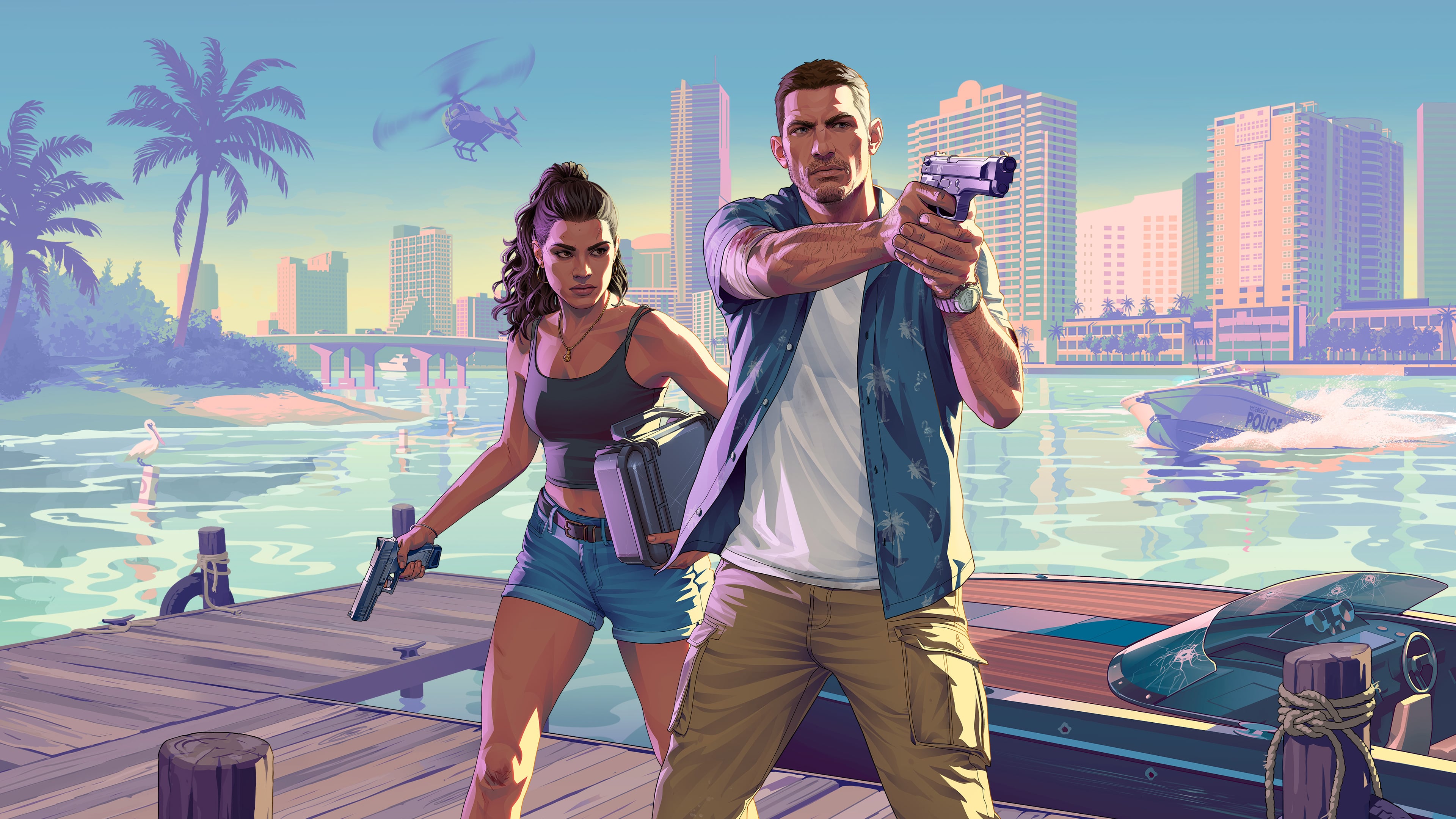
0:00 — Establish the trailer’s broader scope
Trailer 2 expands the official presentation beyond the first reveal. Its longer runtime makes room for more environmental changes and recognizable social settings. Rockstar’s release page and Newswire supply the date and official context; the footage supplies visual evidence. The analysis below treats the video as an edited source, not as a continuous tour through the map.
The distinction is useful because a trailer often cuts between locations to create momentum. The viewer sees variety, but not necessarily the distance, route or chronology connecting those images. Our map page therefore organizes Rockstar’s named regions and source material without tracing a speculative line between trailer frames.
0:24 — Architecture and the urban frame
The city sequences make scale visible through buildings, traffic, signs and crowded public spaces. A composition can communicate density even when it does not show a full street grid. Compare repeated skyline shapes and street-level details, but do not treat a visual resemblance to a real place as proof of a one-to-one map coordinate. Rockstar’s published place names are the safer reference point.
A post-launch guide can answer practical questions that the trailer cannot: whether a player can enter the visible building, which roads connect the area and whether the map names a district. Those details should be recorded from the game and labeled with the build. Until then, screenshots remain official art, not route data.
0:47 — Coastal and water imagery
The trailer’s coastal images widen the setting beyond city streets. Water can frame a location, create a horizon or separate land in a shot. A visible boat or shoreline does not by itself confirm that every vessel is controllable or every channel traversable. The official archive’s region and screenshot labels are more reliable than guesses based on a single frame.
When players can explore the world, a route guide can test access from road to shore, available transport and whether a waterway appears on the in-game map. Each claim should name the starting point and return condition. We will link those tests from the Leonida Keys guide only when another player can reproduce them.
1:18 — Read the edit as a sequence of contrasts
The trailer’s location changes create contrast: populated spaces beside open views, polished interiors beside public street scenes, and moments of quiet beside faster action. That contrast is an editorial effect and a useful observation about the film’s structure. It is not a promise that the game transitions between these settings in a particular mission order.
For open-world pacing, the question after launch will be how those visual contrasts are connected during play. Does a journey give the player time to notice the environment, or does a story task move quickly between set pieces? Only a playable route can answer that. Our walkthrough hub will add tested sequences rather than reverse-engineer mission order from a trailer cut.
1:41 — Environmental detail and player interpretation
A dense frame encourages viewers to search for signs, logos, wildlife and small background events. Close inspection can reveal what Rockstar chose to include, but a detail can be too blurred or brief to identify with confidence. When a claim depends on readable text, cite a source image at adequate resolution and state if the reading remains uncertain.
Not every background object is an Easter egg. A recurring shape may be a visual motif, a reused asset or coincidence. A guide should wait for repetition, a direct reference or a reproducible interaction before it labels an item a mystery. The hints section will collect discoveries only when they can be verified in the game.
2:04 — A region index, not an invented boundary map
Rockstar’s materials name Vice City, Leonida Keys, Grassrivers, Port Gellhorn, Ambrosia and Mount Kalaga National Park. These labels help organize screenshots and provide a vocabulary for future guides. The trailer may show images that viewers associate with those names, but the edit does not draw a border around each region or show every connection.
A fan-made overlay can still be useful when it explains its method and says that the geometry is approximate. GTA6Hint keeps such diagrams separate from publisher art and will not label an estimate as official. Follow the regional index for source links and the news page for new official map information.
Reading Trailer 2 responsibly
The trailer confirms that Rockstar published this second official video and expands the promotional record. It can support observations about visible places, characters and editing choices. It cannot confirm the function of every object, a precise route, a full mission list or the result of a story decision. Those boundaries are the difference between a useful breakdown and a rumor roundup.
Use the scrubber to return to a point, then open the official page and watch the surrounding seconds. If an article makes a claim, ask whether it is visible in the clip, stated by Rockstar or merely inferred. Our story dossiers, missions and hints maintain that separation across the site.
A useful viewing routine
- Watch the official source uninterrupted before pausing individual frames.
- Keep the timestamp beside an observation and separate it from your interpretation.
- Use the region guide or character dossier for context rather than treating an edit as a mission order.
Field note: Replay at normal speed after inspecting a still. Motion and neighbouring shots often explain what a cropped image hides.
Questions & answers
Does the source play inside this page?
Yes. Play and chapter controls activate the official embedded video on this page. The source citation remains visible below the player.
Does the site force 4K playback?
No. Available resolution depends on the official upload, connection, device, and YouTube’s player controls.
Are the chapter labels official mission chapters?
No. They are editorial viewing checkpoints, not a claimed campaign sequence.
Read our editorial policy for verification and corrections.