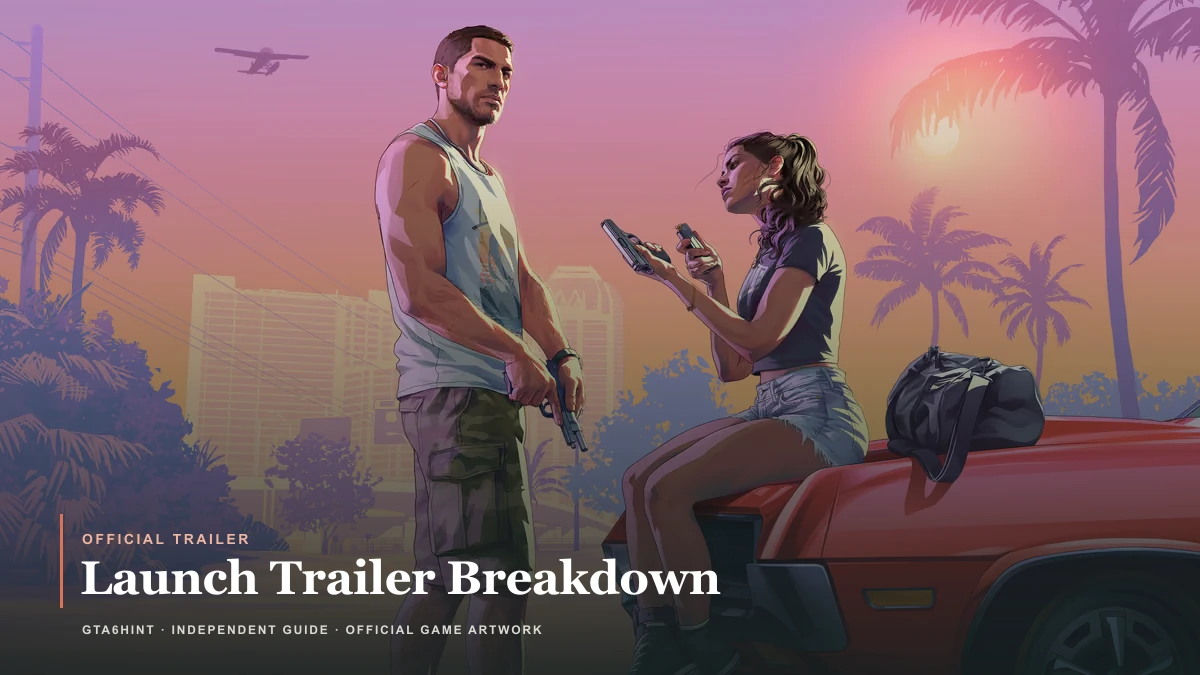
A trailer is a source, not a walkthrough
Rockstar published the Grand Theft Auto VI launch trailer on October 15, 2026. Its official page gives the title and date and identifies the music cue, while the game page frames Jason and Lucia as a pair caught in a criminal conspiracy across Leonida. Those are useful pieces of publisher context. A trailer remains an edited piece of promotion, though, and its shots are not a mission list, a chronological cut or a complete explanation of the game’s systems.
A dramatic edit can put unrelated scenes next to each other. A character appearing in a vehicle, at a venue and in a close-up does not establish that those images occur in that order or within the same mission. A soundtrack transition may connect two images for mood rather than represent a real-time location change. Our analysis describes the visible film and attributes factual statements about its publication to Rockstar.
Read the edit through changes in scale
One useful way to watch a short trailer is to notice how it moves between scale: public spectacle, recognizable place, character interaction and intimate detail. Those changes shape a viewer’s impression of the story before a mission title is known. On a second viewing, pause at each transition and write down only what the frame shows. Add a separate column for interpretation. Keeping those columns apart lets us enjoy the edit without converting a mood into a confirmed plot point.
The official title, release date, music credit and source page are durable citations. Individual scene meanings are not. GTA6Hint will not label a shot as proof of a specific mission, police behavior, relationship outcome or playable event unless Rockstar states that connection or the released game demonstrates it. Readers can compare notes with the source footage on the video hub and send a correction through contact.
What can be confirmed from the official page
The official page identifies this as the Launch Trailer and dates it October 15, 2026. Rockstar’s Newswire announcement says the video features the debut of “Flower in a Hurricane,” by Justice featuring Tame Impala, SZA and King Gizzard & The Lizard Wizard. The wider game description says Jason and Lucia’s story is set in Vice City and extends across Leonida, with the pair caught in a criminal conspiracy. Those statements can be summarized with direct links.
A music credit does not confirm the full in-game radio lineup, additional licensed tracks or availability in every version. Likewise, a trailer’s title does not establish that it contains the final build or a complete gameplay sequence. Unless Rockstar labels a video as captured in-game, do not infer recording method from visual style. The extended look has its own official description, which calls it PlayStation 5 in-game footage; that wording should not be generalized to every promotional film.
Avoid the screenshot-to-coordinate trap
Screenshots and trailer frames can be cropped, color-graded or captured from a moving camera. Perspective can make buildings appear closer, and a landmark at the edge of a frame may sit outside the playable boundary. A frame rarely contains enough context to determine map coordinates. The official media archive is best used to recognize publicly named places and imagery, not to build a precise atlas without a method.
After release, players may compare a captured scene with the in-game map and record an approximate location. That guide should state which platform and version were used and show enough surrounding context for another person to reproduce it. Our map page will keep official regional art separate from guide-made pins. The mission hub and hints hub will add trailer links only when the corresponding task or location can be verified in-game.
A repeatable way to annotate the film
First, open the official video and note its displayed duration and source page. Second, create time markers for visible transitions, using a timestamp that returns to the same frame. Third, describe the image literally: who or what is visible, whether text can be read and whether the camera moves. Fourth, put interpretation in a separate paragraph, label it analysis and avoid stating that it is confirmed. Finally, link the official page and update a timestamp if the video is replaced or edited.
This method keeps an article useful long after release. It also gives readers a way to challenge a scene description. We may disagree about whether an image suggests a particular relationship or theme; that disagreement belongs in analysis, not in the confirmed-facts ledger. A strong trailer breakdown acknowledges uncertainty without making every possibility sound equally likely.
Where this sits in wider coverage
Trailer analysis works best beside material that answers different questions. The news section records dated announcements and their sources. The story dossier lists character details Rockstar has published. The mission section is reserved for playable routes that can be tested after release. The Leonida map collects named regions and clearly labeled visual references. These links let readers move from interpretation to evidence without mistaking one for the other.
Watch the whole trailer once without pausing, then revisit it with the scrubber on this page. Compare the musical structure with the scene order, note where the edit withholds context, and write down questions that only the game can answer. Curiosity is valuable; certainty should be earned. Until Rockstar supplies more detail, this article stays focused on public material and avoids spoiler claims based on rumor.
Editorial conclusion
The launch trailer is a compact statement of tone and a dated piece of official marketing. Its strongest confirmed facts come from Rockstar’s accompanying copy: the video’s publication, its named song and the game’s public story premise. Everything else should be marked as visual observation or interpretation. We will revise this page when an official source changes or when the released game makes an open question testable.
Follow the official trailer, keep its publication date in mind, and return to our latest GTA VI updates for changes. The distinction between promotion, observation and gameplay evidence is the foundation of a useful guide. A scene can inspire a theory; the article should tell the reader exactly when the evidence stops and that theory begins.
Keep a guide that another player can follow
- Record the platform, game version, starting condition, and actual objective wording.
- Keep required steps separate from optional discoveries and editorial preferences.
- Describe the recovery point immediately after any step that can fail.
Field note: The completion roadmap is useful only when a requirement can be traced to the game’s own record or a reproducible result. Leave an uncertain total open.
Questions & answers
Is this a completed in-game route?
The page’s testing status defines its scope. A pre-release planning guide does not claim a completed campaign run.
Are chapter orders or collectible totals guessed?
No. A complete route needs a stated method and evidence from the released game or an explicit publisher source.
How can a reader report a mismatch?
Use the contact page and include the platform, version, starting state, and the step whose result differs.
Read our editorial policy for verification and corrections.
GTA6Hint is an independent publication and is not affiliated with Rockstar Games or Take-Two Interactive.